
UNILORIN researchers highlight contributions to agric, climate resilience and human development
By Mustafa Abubakar
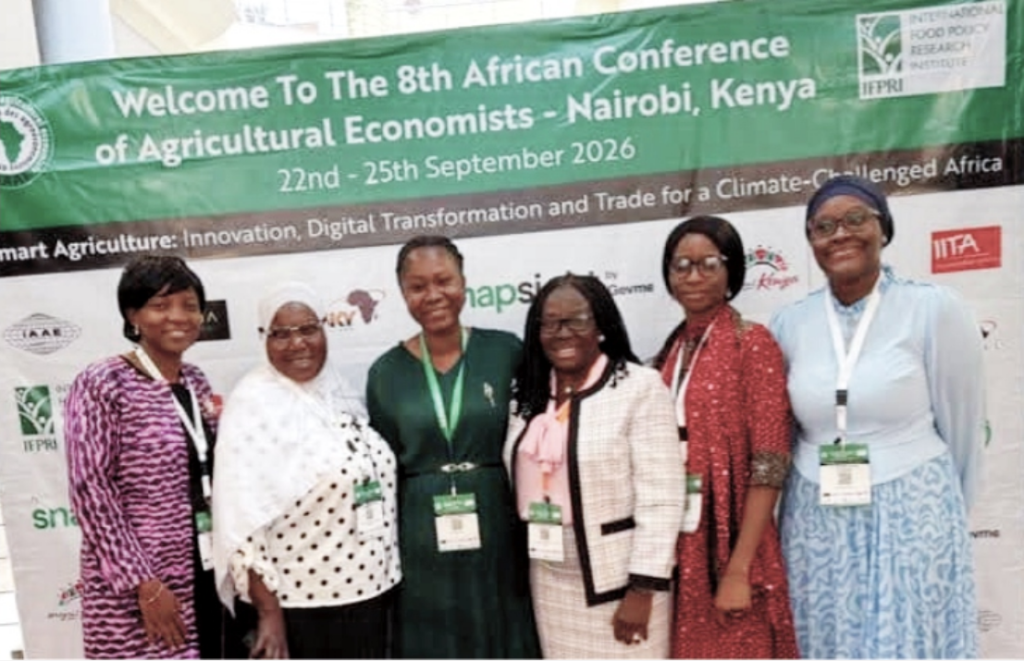
Researchers from the University of Ilorin have made a strong showing at the 8th African Association of Agricultural Economists (AAAE) Conference with seven research presentations highlighting the contributions of the University to agricultural research, climate resilience, innovation, and human development.
The Conference, held in Nairobi, Kenya, from last Tuesday to Friday (September 22–25, 2026), with the theme, “Smart Agriculture: Innovation, Digital Transformation, and Trade for a Climate-Challenged Africa”.
Presentations by researchers from the University addressed critical issues affecting agricultural productivity, food security, rural livelihoods, climate adaptation, financial innovation, and the welfare of vulnerable households across Nigeria and sub-Saharan Africa.
Some of the researchers from the University received grants and travel support from development and research organisations, including the International Food Policy Research Institute (IFPRI), the International Institute of Tropical Agriculture (IITA), and the AAAE.
One of the studies, presented by Dr Khadijat Amolegbe, the Head of the Department of Agricultural Economics and Farm Management, examined “Food Price Shocks, Household Livelihood Diversification, and Early Childhood Development: Evidence from Nigeria.”
The study investigated the relationship between food price fluctuations, household livelihood strategies, and early childhood development in Nigeria. It used food price data from January 2017 to August 2023, alongside information from the 2023/2024 General Household Survey, covering approximately 4,770 households.
The research focused on children aged four to six and found that maize price shocks were negatively associated with some child development outcomes, while egg prices showed positive associations in certain models. It also indicated that livelihood diversification could help households cushion the effects of maize price shocks.
The study further identified children aged five as particularly vulnerable in some areas, while the relationship between maternal agency and child development outcomes was found to be mixed. The researchers noted that the findings were observational and correlational, rather than proof of direct causation.
Another presentation by Belewu Kafayat Yemisi, Oluwadare Oluwasegun Akinola, Muhammed Sherifat Mojisola, and Bamidele Oluwagbemileke Fortune focused on “Gender Dynamics in Adoption of Climate-Smart Agricultural Practices and Technical Efficiency among Tuber Farmers in Nigeria.”
The study examined the influence of gender related factors on the adoption of climate smart agricultural practices and technical efficiency among tuber farmers in Kwara State.
It highlighted the roles of access to extension services, credit facilities, institutional support, and other agricultural resources in improving farmers’ capacity to adopt climate smart practices and enhance productivity.
Similarly, Dr Mercy Funke Salami, Opeyemi Eyitayo Ayinde, and Michael Ross Carter presented a study, titled “Trust, Conflict, and Inclusive Rural Welfare: Evidence from Farmer-Herder Interactions in Nigeria.”
The research, conducted in Niger State, involved 160 respondents and 84 participants in focus group discussions. It examined the relationship between trust, farmer herder conflict, and rural welfare.
The study reported that 78.75 per cent of farmers and 57.5 per cent of herders had experienced conflict within the preceding three years. It also found differences in recovery periods, with farmers reporting an average recovery period of 7.36 months compared with 2.76 months for herders.
The researchers emphasised the importance of trust building, social interaction, and inclusive approaches to reducing conflict and improving rural welfare.
Prof. Ayinde and Dr Salami also presented in an invited special session another study titled “Knowledge Integration Framework for Climate-Resilient Agriculture in Sub-Saharan Africa.”
The presentation proposed a framework for integrating different forms of knowledge, including scientific knowledge, indigenous and local knowledge, farmers’ experiential knowledge, and institutional knowledge, in the development of climate resilient agricultural systems.
The study identified knowledge silos, limited collaboration, and power imbalances as challenges to effective knowledge integration. It advocated knowledge co-production and inclusive participation to ensure that farmers and other local stakeholders play meaningful roles in climate adaptation and agricultural policymaking.
In another presentation, Adeola O. Olarewaju and Opeyemi E. Ayinde examined “Assessing Impact of Land Use Variability on Maize Farm-Level Productivity and Efficiency among Smallholder Farmers in Nigeria.”
The study covered 372 households across Kwara, Niger, and Kogi States, comprising 186 adopters and 186 non-adopters. The researchers applied stochastic frontier analysis, propensity score matching, and the endogenous treatment effect model to assess productivity and efficiency.
The study reported efficiency levels of 0.84 among adopters and 0.79 among non-adopters, with a reported effect of 21.9 percentage points. It also considered the influence of land tenure arrangements and agroforestry practices on agricultural productivity and efficiency.
The researchers stressed the need for land-use policies and agricultural interventions that promote sustainable land management and support smallholder farmers.
Mercy Jacob, who recently concluded her Ph.D., is also presenting research from her doctoral work at the conference. She, alongside Opeyemi Eyitayo Ayinde, Olubunmi Abayomi Omotesho, and Justinah Adwoa Onumah, presented a study titled “Determinants of Intensity of Use of Financial Innovation among Smallholder Maize Farmers in North Central Nigeria.”
The study used data from the ALL-IN panel covering 2021–2024 and applied a double-hurdle model. It was guided by the Unified Theory of Acceptance and Use of Technology (UTAUT) and the Agricultural Innovation System framework.
The research examined how performance expectancy, effort expectancy, social influence, climate-related risks, and land tenure arrangements influenced farmers’ use of financial innovations.
It identified the relevance of agricultural extension services, farmer organisations, and inclusive financial systems in improving access to and use of financial innovations among smallholder maize farmers.
The seventh presentation, by Ibrahim Hussain Kobe and Grany Mmatsatsi Senyolo, was titled “Effect of Neglected and Underutilised Species in Mitigating Climate Shocks on Food Insecurity in Nigeria.”
The study used data from the National Agricultural Sample Survey and the 2022/2023 Harmonised Living Standards-related household data, covering 2,799 matched household heads.
It applied the Food Insecurity Experience Scale, ordinary least squares, and the Multivariate Probit model to investigate the relationship between neglected and underutilised species, climate shocks, and food insecurity.
The researchers examined the role of neglected and underutilised crops and livestock in supporting household resilience and food security. However, the study indicated that diversification did not uniformly reduce all forms of food insecurity, suggesting that the impact of such strategies could vary according to household and environmental conditions.
The seven presentations collectively demonstrated the University of Ilorin researchers’ engagement with contemporary agricultural challenges, including food price instability, climate change, gender inclusion, rural conflict, sustainable land use, financial technology, household resilience and food security.
The studies also reinforced the importance of evidence-based research, local knowledge, inclusive policies, and innovative approaches in strengthening agricultural systems and improving livelihoods across Africa.
