
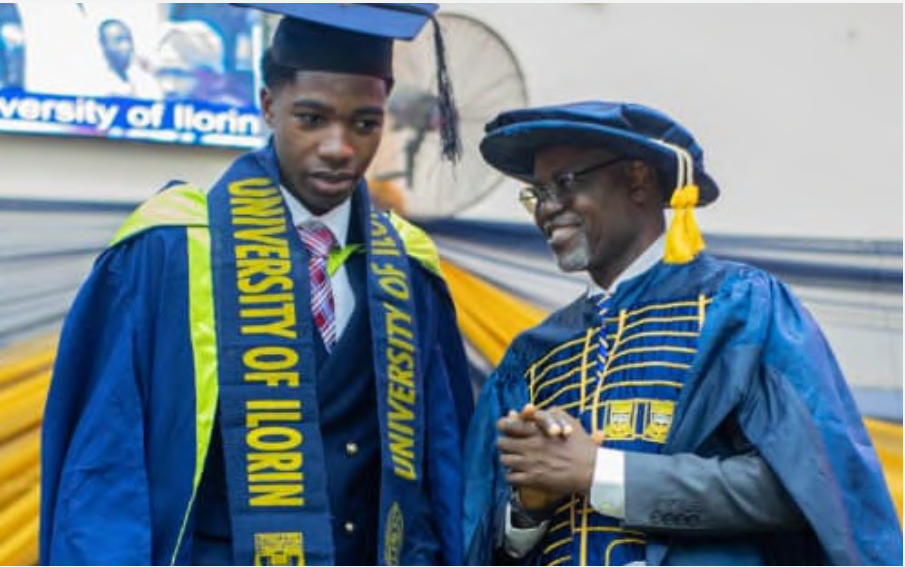
How I made a perfect 5.00 CGPA-Olusegun, UNILORIN’s best graduating student
By Abubakar Imam
The best graduating student for the 2025/2026 academic session at the University of Ilorin, Mr Francis Olusegun, has revealed how he made history by graduating with a perfect 5.00 Cumulative Grade Point Average (CGPA).
In an interview with UNILORIN Bulletin last Wednesday (October 21, 2026), Mr Olusegun, who graduated from the Department of Mathematics, explained that his journey to academic excellence was not simply about reading for long hours or possessing exceptional intelligence. He said that it involved making difficult choices, knowing when to withdraw from competing interests and developing a study approach that worked for him.
Mr Olusegun, who hails from Ogbomoso, Oyo State, explained the sacrifices behind his achievement, his determination to become the University’s overall best graduating student, the role of his family in his academic journey and his plans for postgraduate studies.
He explained that he had to put relationships aside to concentrate on his studies as he declined to disclose the reasons behind the decision.
Explaining how he managed his interests, he said: “I do not do too many things at the same time. I am not a very social person, and I have interests in many things, but when they conflict, I have to drop some of them.”
Mr Olusegun explained that his involvement in Junior Chamber International (JCI) and Minddrive began in his third year, while he participated in animal welfare activities in his fourth year. He also had interests in sports and technology but had to make difficult decisions about the activities he could continue.
According to him, students should not attempt to do everything at once but should concentrate on activities that support their ambitions.
“My own take is just don’t do plenty things, just do few that will complement what you want to achieve. If it is leadership, take leadership. If it is volunteering, take volunteering. I did some volunteering too. So, just do few things that really count,” he said.
Beyond the sacrifices, Mr Olusegun attributed his academic success to developing a personal structure that guided his decisions and helped him remain focused on his long-term objective.
He cautioned students against assuming that discipline alone would guarantee academic excellence without a clear understanding of their individual goals and the practical steps required to achieve them.
He further urged students to understand themselves, their goals and their present circumstances before applying general principles of academic success.
Mr Olusegun also revealed that his approach to studying was flexible rather than tied to a rigid timetable. He said he was willing to change his reading methods whenever he discovered that a particular strategy was no longer effective.
Asked whether he followed a strict study timetable, Mr Olusegun explained that he preferred to assess his performance and adjust his methods instead of continuing with an approach that was not producing the desired results.
“My reading system is very flexible. I don’t believe in one particular way. Once I carry a structure or a way of doing things, and it’s not working again, I quickly improve it. I read after class. I believe in consistency,” he said.
He further explained that his study approach involved revisiting what he had learnt in class and making sure he understood the material rather than relying exclusively on a predetermined reading schedule.
Explaining how he responded when his plans became difficult to maintain, Mr Olusegun said that “what I do is, once something is not working for me again, I throw it away. If I create a timetable and it’s not working, I switch to another one. So my flexibility is the key, and my consistency.”
He disclosed that his ambition to become UNILORIN’s overall best graduating student had been developing since 2019.
He explained that seeing reports of outstanding graduates from other universities inspired him to set a similarly ambitious target for himself, adding that his determination grew stronger after he recorded a perfect 5.00 CGPA in his first year, making the possibility of graduating with the same result more tangible.
Asked whether he had always believed he could become the University’s best graduating student, Mr Olusegun explained that he initially wanted to stretch himself and test the limits of what he could achieve.
“I thought, if it was possible, I could stretch myself and go for it. Everyone can have a first-class but it’s not my original target. I wanted to be the overall best graduating student,” he said.
Mr Olusegun maintained that he did not score below 70 in any course throughout his academic journey, a record that reflects the consistency he said he brought to his studies.
According to him, the achievement was the fulfilment of a goal he had pursued over several years, supported by a willingness to make difficult choices and continually improve his approach to learning.
Mr Olusegun acknowledged the contributions of his family members to his academic journey.
He said his parents had supported his education and helped provide the conditions that enabled him to pursue his academic ambitions.
Recalling the encouragement he received, he said: “My parents did not have tertiary education; their highest level of education was secondary school. My uncle and elder sister were among the few people who understood my academic standing.”
He explained that encouragement from family members and people who believed in his potential helped strengthen his determination.
“Most of the motivation came from me. I also received encouragement from a few scholars in the university and people in my church,” he said.
Mr Olusegun added that his family had continued to support him throughout his academic journey, expressing appreciation for the people who stood by him as he worked towards his goal.
His experience highlights how personal determination and encouragement from others can work together in the pursuit of academic excellence.
Mr Olusegun urged students struggling with poor academic performance to identify the causes of their difficulties, seek appropriate guidance and adopt practical strategies to improve.
He advised students not to assume that their current academic challenges were permanent but to examine their circumstances and identify where changes were needed.
“First thing, have your personal structure. That’s the mistake that people make. Have your own way of doing things,” he said.
He explained that students needed to understand their individual circumstances before deciding how best to address their academic challenges.
“The first thing is to sit down and identify where the problem is coming from, what is causing the problem, then you look up to mentors, scholars or people you look up to. Explain your situation to them so they can help identify the problem and suggest possible solutions,” he said.
He added that seeking help should be followed by practical action.
“Once you have possible solutions, apply them. But the first thing is to be interested in improving your results,” he said.
On his plan for the future, Mr Olusegun said he intends to pursue a Master degree abroad and may subsequently proceed to a doctorate. He disclosed that he was considering fields such as Mathematical Biology and Mathematical Epidemiology, which apply mathematical techniques to biological processes, infectious diseases and public health challenges.
Explaining his plans, he said: “My next step is to pursue a Master degree abroad. In five years, I may be doing my PhD or may have completed it. It depends on the programme I pursue.”
He said he was interested in applying mathematics to real-world problems, particularly those related to infectious diseases and public health.
“I could work with public health organisations, or I could work with one abroad. If I pursue a programme in Mathematical Epidemiology, I will also be working in the health field because epidemiology deals with diseases,” he explained.
His perfect 5.00 CGPA is the culmination of an ambition he had nurtured for years. Yet, as his own words reveal, the journey was shaped not only by academic effort but also by the personal structure he developed, the distractions he chose to limit and the willingness to change his methods whenever they stopped working.
His message to students is clear: ambition provides direction, but achieving it requires a deliberate plan, sustained commitment and the courage to make difficult choices along the way.
