Aremu canvasses integrated waste management approach
By Abubakar Imam
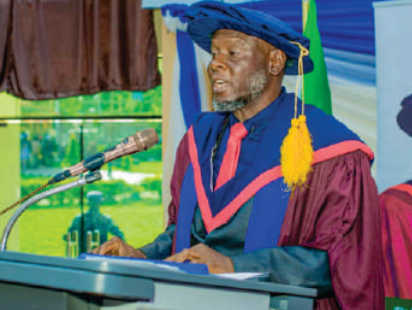
The pioneer Head of the Department of Water Resources and Environmental Engineering, University of Ilorin, Prof. Adeniyi Saheed Aremu, has called on stakeholders, particularly the government, to consider the adoption of integrated smart waste management system to ensure not just a cleaner environment but also facilitate the transformation of waste to wealth.
Prof. Aremu gave the advice last Thursday (June 11,2026) while delivering the 303rd Inaugural Lecture of the University, titled “Municipal Solid Waste: Complexities in the Transition from Cradle to Grave” at the University Auditorium.
The don also urged government to invest in modern solid waste management infrastructure such as Internet of Things (IoT) that would enable smart waste bins, recycling, material recovery and waste-to-energy facilities, sanitary landfills, transfer stations, greener and fuel-efficient collection vehicles, and other local engineering solutions geared towards a clean and healthy society.
He said that the facilities should have sensors for real-time tracking, monitoring and transmission of information to a designated server for analyses by experienced professionals.
Prof. Aremu, who recently completed his tenure as the Managing Director and Chief Executive Officer of the Lower Niger River Basin Development Authority (LNRBDA), Ilorin, also called on government to promote at-source sorting/separation so as to assist in materials recovery, reduction in management costs, and elimination of hazardous wastes from the waste stream right from the point of generation. He added that the waste bins should also be color-coded and separation should be at household level or at the location of the municipal waste bin.
The Inaugural Lecturer, who also served as the Coordinator of the National Water Resources Capacity Building Network for North Central Nigeria from 2015 to 2017, also called for the integration of spatial dynamics with periodic data auditing. He said that strategic spatial assessment, planning and analyses should be carried out by municipal authorities before siting waste bins and landfills so as to maximise service coverage, and minimise economic and negative environmental impacts.
He also pointed out that data on solid waste should be documented and audited periodically in order to monitor the existing solid waste management system and to make financial, regulatory and logistic decisions.
Prof. Aremu also stated the need to optimise vehicle capacity with waste bin size in order to ensure that multiple waste bins are picked up in a single collection operation. He added that government should also promote the use of push carts, wheelbarrows, tricycles, animal-drawn carts and wagons, trolleys, bicycle trailers, and locally fabricated equipment for pre-collection operations at inaccessible and narrow roads.
Since most of a city’s expenses is on collection operation, Prof. Aremu explained that formulation of a standard operational schedule with digital routing before assigning collection vehicles to trips would assist in minimising collection time and cost, and equally aid workload distribution. He reasoned that the collection period by the collection crew should be early in the morning or late in the night to minimise time lost due to delay and high traffic.
He also suggested that sustainable cost recovery strategies should be put in place by the government to offset the cost of solid waste management. These strategies, according to the Inaugural Lecturer, should include imposition of reasonable user fees, extended producer responsibility, reuse or recycling of solid wastes, and material/energy recovery.
The don equally canvassed that informal solid waste pickers, scavengers and the small-enterprise waste collectors should be encouraged by the government and incorporated into the Renewed Hope Agenda of the government. He added that public education by all stakeholders should be geared towards denouncing the stigma attached to workers in the solid waste management industry especially the scavengers.
Prof. Aremu also called for more private sector involvement in solid waste collection, material/energy recovery, and landfill management is encouraged. He said that community-based organisations should be inspired to participate in various aspects of solid waste management as he proposed a decentralised system where government’s role would be that of an overseer, regulator or financial supporter while private enterprises should be the service providers.
While pointing out that markets should be provided for recycled goods and generated energy, Prof. Aremu also suggested vigorous public awareness campaigns by government using social media platforms, and electronic and print media on solid waste management strategies and dangers of indiscriminate dumping of wastes.
He added that collaboration among all stakeholders in the waste management industry should be strengthened in areas such as knowledge and technology transfer, information sharing, raising awareness, funding and policy formulation.
A comprehensive master plan, according to the Inaugural Lecturer, should be developed for solid waste management in Nigeria to reflect sustainable management options, targets, benchmark for improvements, robust regulations and financial sustainability as he also noted the need for all stakeholders in the waste management industry to move towards circularity in our waste management efforts.
Drawing from his experience outside the campus, Prof. Aremu encouraged academics who are serving outside the academia to give good examples by transforming challenges into opportunities for growth.
The Inaugural Lecture, which was presided over by the Vice Chancellor,Prof. Wahab Olasupo Egbewole, SAN, was also attended by the Principal Officers of the University as well as relations, friends, students, colleagues and mentees of Prof. Aremu from far and near.
