UNILORIN holds seamless 2026 post-UTME exercise
…as 15,344 candidates register
By Mustafa Abubakar and Maryam Abdullahi
The University of Ilorin has successfully conducted its 2026 Post-UTME screening exercise, with a total of 15,344 candidates registered for the exercise.
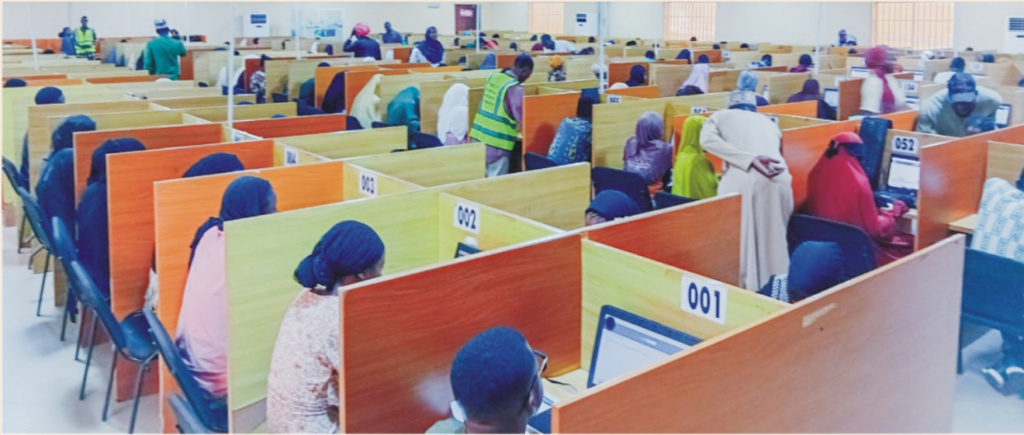
The screening, which was conducted over three days, from Thursday, August 13, 2026, to Saturday, August 15, 2026, recorded 6,000 candidates on the first day, 6,000 on the second day, and 3,344 on the third day. The exercise was widely described as seamless, with its smooth conduct attributed to meticulous planning, early preparation, effective coordination, strategic deployment of technology, and the commitment of staff and volunteers.
Speaking during an assessment tour of the CBT Centre venue of the screening exercise, the Vice Chancellor, Prof. Wahab Olasupo Egbewole (SAN), who monitored the exercise, said the early preparation and coordination of the University team, headed by the Deputy Vice Chancellor (Academic), Prof. Taibat Moji Bakare-Odunola, were central to the smooth commencement and conduct of the examination.
Prof. Egbewole described the process as well organised and well coordinated, commending the officials responsible for the exercise.
He said the preparation of the University was deliberate, noting that officials were already on ground hours before the scheduled commencement.
The Vice Chancellor said, “We were all here by around 6:30 a.m., despite the fact that the exam was supposed to start at 9:00 a.m. This is to make sure that there is no problem that the examination is seamless, and we start at the dot of 9:00.”
In her remarks, the Deputy Vice Chancellor (Academic), Prof. Taibat Moji Bakare-Odunola, disclosed that officials were on ground as early as about 6:30 a.m., well ahead of the scheduled 9:00 a.m. commencement time, to ensure that all arrangements were in place before candidates began their examinations.
The Deputy Vice-Chancellor described the smooth conduct of the exercise as another demonstration of the University’s “Better by Far” standard and the value it places on efficient service delivery to prospective students.
She noted that the success of the exercise was the result of the collective efforts of the University Management, academic and non-teaching staff, security personnel, medical teams, ICT personnel and other officials involved in the screening process.
Also speaking, the Deputy Vice-Chancellor (Management Services), Prof. Olalere Adeyemi, expressed satisfaction with the organisation of the exercise, describing the process as “progress upon progress.”
Prof. Adeyemi commended the arrangement from the University gate, saying that candidates were entering the campus without unnecessary rush.
He said that biometric verification and other processes were carried out by trained personnel, while security personnel, medical officers and staff members were also on ground to supervise the exercise.
Prof. Adeyemi described the organisation as a good development that could serve as a model for other universities.
“I think this is a very good one, and other universities can emulate this,” he added.
On his part, the Deputy Vice Chancellor, Research, Technology and Innovation, Prof. Muhtar Adeiza Etudaiye, also expressed satisfaction with the conduct of the exercise.
Prof. Etudaiye described the process as orderly and organised, saying, “As you can see, everything is proceeding very orderly, in a very organised manner.
He explained that preparations began from the point candidates entered the campus, where they went through security checks and other biometric processes.
The immediate past Director of Computer Services and Information Technology (COMSIT), Prof. Rasheed Gbenga Jimoh, attributed the smooth conduct of the exercise to the University’s increasing integration of ICT into its admission and examination processes.
Prof. Jimoh, a Professor of Computer Science, said the achievement should be credited to the current leadership of the University for creating an enabling environment for seamless ICT integration.
“Whatever milestone we achieve here should be credited to the current leadership of the University. The management has paved the way for seamless integration of ICT in a way that will improve our processes as a university,” he said.
He explained that the University’s technology-driven process began from the application stage and continued through examination.
“From application to examination, applicants apply seamlessly. As we speak, their identity is validated as they are coming in, through name validation,” he said.
Prof. Jimoh said the University had also moved beyond the traditional process of asking candidates to bring physical documents for verification.
According to him, the National Identity Management Commission (NIMC) validates candidates’ identities, while their O’ Level results are validated through the relevant examination bodies.
“As we speak, their O’ Level has been validated by the examination bodies, be it NECO, WAEC or NABTEB. So, we have passed the stage of, ‘Go and bring your card, let’s check,” he said.
Prof. Jimoh said the University of Ilorin was setting the pace in ICT integration, adding that candidates were scheduled in a manner designed to prevent rowdiness at examination venues.
Looking ahead, Prof. Jimoh disclosed that the University had tested the possibility of conducting an AI-enabled examination.
He said the platform had been tested and was functional, but management decided to pause its full deployment because of concerns over the digital divide.
According to him, the solution requires full internet access and stable connectivity throughout the examination.
He explained that candidates would not be able to proceed with the examination until the network was stable enough to capture the required coordinates, effectively providing a mechanism for monitoring the examination remotely.
He said the University was conscious of the possibility that candidates in rural areas and communities with inadequate internet access could be disadvantaged.
“For that reason, we said we know that Nigeria has not gotten there. Some are in the villages, and those people can be deprived,” he said.
Prof. Jimoh said management therefore decided to continue testing the solution with smaller numbers of candidates before considering wider deployment.
He said the decision reflected the University’s concern for inclusivity and fairness.
Also speaking, the new Director of COMSIT, Prof. Sidiqat Aderinoye-Abdulwahab also expressed satisfaction with the smooth conduct of the examination.
Speaking on the factors responsible for the seamless exercise, she linked the success to the “Better by Far” philosophy and the value attached to the institution’s processes, adding that “the value of the University is the simple magic.”
In his comment, the Chairman/Director of the Computer-Based Test (CBT), Prof. Adeyinka Tella, said that the early preparation in ensuring the smooth commencement of the examination contributed to the success recorded.
He said that the “Better by Far” standard was reflected in the organisation of the exercise and the attention given to details before candidates commenced the test.
He also noted officials’ presence as early as 6:30 a.m., despite the examination being scheduled for 9:00 a.m.
