
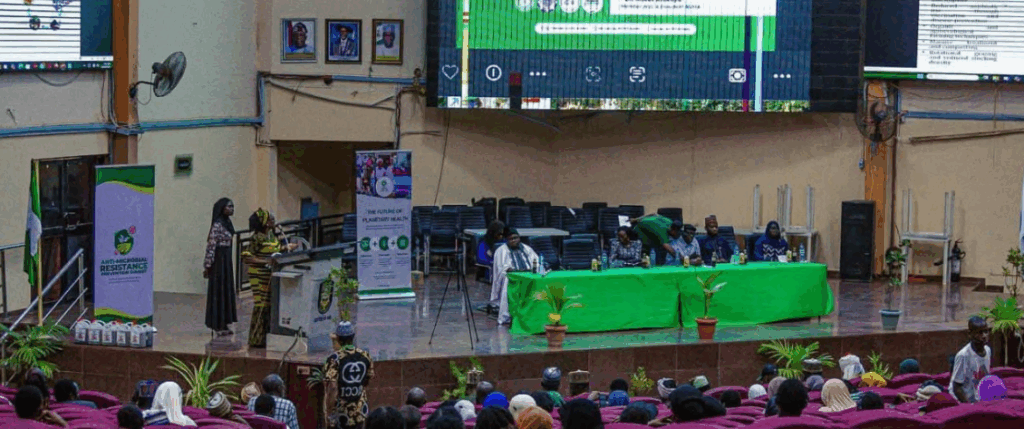
UNILORIN experts lead national call for action at AMR prevention summit
By Mustafa Abubakar
Experts from the University of Ilorin have raised strong concerns over the rising threat of Antimicrobial Resistance (AMR) in Nigeria, calling for urgent reforms in agricultural, pharmaceutical, veterinary, and public health practices.
The submission was made on Wednesday (November 19, 2025) at the Anti-Microbial Resistance Prevention Summit held at the University Auditorium.
The summit was organised by the AMR Club, SDGs Club, Planetary Health Club, and Students Livestock Estate Club in partnership with the Thriving Youth Leadership Network, founded and facilitated by Gobir Ibrahim Musa, an alumnus of the University.
In her submission, the immediate past Dean of Agriculture, Prof. Oluyemisi B. Fawole, warned that Nigeria’s food system is increasingly endangered as antibiotic residues continue to damage soil health. She said many farmers rely excessively on antibiotics, which accumulate in the soil and promote the emergence of resistant microorganisms, eventually finding their way into food chains.
She stressed that sustainable agricultural practices such as crop rotation, composting, bio-fertilizers, integrated pest management, and improved livestock hygiene remain the most reliable approach to reducing antibiotic dependence. She urged universities, especially UNILORIN, to invest more in soil microbiology laboratories and surveillance systems to strengthen the country’s food safety framework.
Also speaking, Dr AbdulMalik Aliyu, who is the Head of Pharmaceutical Microbiology and Biotechnology at the University, described antibiotic misuse as the primary driver of resistance. He said improper use, such as incomplete dosage, sharing drugs, or using leftover antibiotics gives bacteria the opportunity to mutate.
He insisted that pharmacists must serve as gatekeepers by ensuring that antibiotics are dispensed strictly on prescription, while laboratory testing should always guide treatment decisions. Strengthening laboratory capacity and drug stewardship training, he noted, is vital to reducing AMR nationwide.
In the same vein, Dr Oluwafemi Daodu, the Head of Veterinary Microbiology, explained that resistant microorganisms spread rapidly through poorly managed farms where overcrowding, unhygienic conditions, and uncontrolled drug use are common. He advised livestock keepers to adopt vaccination, routine diagnostic testing, and professional veterinary consultation before administering drugs.
He called for increased investment in research to develop safe local alternatives to antibiotics and urged government agencies to support veterinary institutions with stronger surveillance systems.
In her remarks, the Kwara State Commissioner for Health, Dr Amina Ahmed El-Imam, noted that AMR now threatens public health more urgently than ever, with hospitals witnessing rising treatment failures due to antibiotic-resistant infections. She said the Kwara State Government is strengthening surveillance, enforcing responsible drug use, and promoting community enlightenment to curb AMR.
She commended UNILORIN students for initiating a summit that aligns with global health priorities, assuring them that the state government would continue to collaborate with researchers and institutions to reduce drug misuse across Kwara communities.
Representing the President of the Nigeria Veterinary Medical Association (NVMA), Dr Musa Imam Abubakar outlined national strategies for AMR prevention, stressing the One Health approach, improved laboratory networks, and effective regulation of antibiotic sales.
In her remarks, the Kwara State Commissioner for Livestock Development, Hon Oloruntoyosi Ayobola Thomas, warned that AMR undermines livestock productivity, leading to major economic losses. She however reaffirmed government support for the newly launched Students Livestock Estate, describing it as a model for youth-led agricultural practice in the state.
The President of the Association of Fish Farmers in Kwara (AFFAK), Brig Gen Tayo Olasupo, who spoke on the misuse of antibiotics in fish farming, explained that resistant bacteria from ponds often contaminate water bodies, and urged farmers to adopt safer aquaculture practices.
Also speaking, an environmental advocate and Co-Founder of the Adun Group, Dr Bola Yusuf, described the environment as a “hidden reservoir” of resistant organisms due to untreated pharmaceutical waste, farm runoff, and contaminated water systems, calling for investment in waste treatment and environmental regulation
