
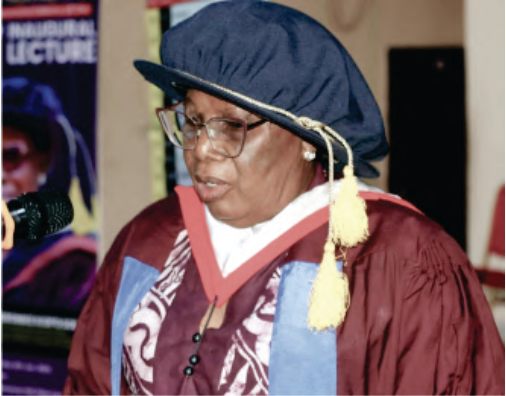
Soetan tasks stakeholders on student-centred teaching
By Abubakar Imam
A former Head of the Department of Educational Technology, University of Ilorin, Prof. Aderonke Kofo Soetan, has urged teachers to ensure they discharge their duties through student-centered styles, saying that teachers should always use appropriate instructional resources to awaken learners’ potentials and facilitate meaningful learning.
Prof. Soetan gave this advice last Thursday (January 8, 2026) while delivering the 295th Inaugural Lecture of the University, titled “Learning Potentials: The Right Language and Instructional Resources”, at the University Auditorium.
The Inaugural Lecturer advised educational institutions to adopt assistive technologies that would support learners with special needs. She said that doing so would ensure inclusive access to language learning and instructional resources.
Prof. Soetan also implored educational technologists, curriculum developers, and language educators to collaborate with one another in designing, developing, and producing culturally relevant instructional materials in indigenous languages to enhance comprehension and preserve linguistic heritage. She equally urged the government and educational stakeholders to enforce the implementation of the National Policy on Education and National Language Policy by ensuring that mother-tongue instruction, especially Yorùbá, is effectively used at the early stages of education with adequate instructional resources.
The Inaugural Lecturer also said that schools at all levels should integrate educational technologies such as mobile applications, multimedia tools, and interactive boards into language teaching to enhance and improve learners’ engagement and learning outcomes.
Prof. Soetan equally canvassed the introduction of professional development programmes that would train teachers on the design, improvisation, and effective use of instructional resources, particularly technology-based and mother-tongue instructional materials. She said that teachers should also be encouraged to improvise instructional materials using locally available resources within learners’ environments to enhance understanding where standard materials are unavailable.
Prof. Soetan also encouraged institutions to establish and adequately equip instructional resource centres where teaching materials can be produced, stored, borrowed, and supported teaching practice and classroom instruction. The Inaugural Lecturer, who had previously served as Sub-Dean of the Faculty of Education, University of Ilorin, also said that it is important for parents and communities to be sensitised on the importance of using the mother tongue at home to complement school efforts and ensure early language acquisition and cultural continuity.
She additionally stressed the inclusion of field trips, two-dimensional and three-dimensional models, pictures, games, simulations, animations and online resources, all of which, she said would enhance learner’s understanding and add value to teaching and learning.
Prof. Soetan, who equally served as the Chairman of the Faculty of Education Dress Code Committee, also stressed that instructional resources across all subject areas should be systematically utilised both within and beyond the classroom, to enhance learner’s skill acquisition, promote effective learning, and address emerging challenges in educational technology.
She was also of the conviction that researchers should be encouraged to explore the use of Artificial Intelligence, Natural Language Processing, and digital innovations for indigenous language documentation, learning, and preservation, especially for Yorùbá language.
Drawing from her personal experience, Prof. Soetan charged senior academics in the services of various universities to always provide adequate mentorship to upcoming ones for them to also attain progress in their careers.
The Inaugural Lecture, which was presided-over by the Vice Chancellor, Prof. Wahab Olasupo Egbewole, SAN, was attended by friends, students and colleagues of Prof. Soetan from far and near.
