
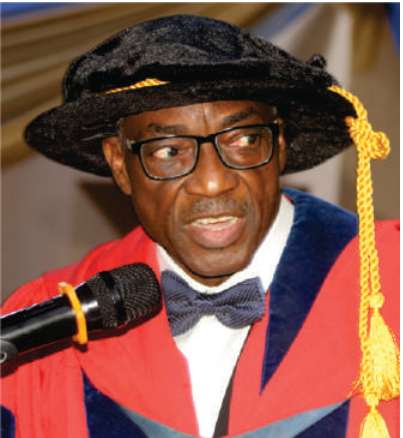
Reconfigure Nigeria’s education governance structure, Fajonyomi tasks stakeholders
By Abubakar Imam
A former Director of the Institute of Education (IOE), University of Ilorin, Prof. Ayodele Anthony Fajonyomi, has called for the reconfiguration of the country’s education governance framework to enhance lifelong learning principles.
Prof. Fajonyomi, who teaches at the Department of Adult Education, made this call last Thursday (February 19, 2026) while delivering the 297th Inaugural Lecture of the institution, titled “From Wobbling to Thriving Development: The Transformative Power of Adult Learning And Education for Sustainable Future”.
The renowned educationist also suggested the renaming of the Federal Ministry of Education as the Federal Ministry of Lifelong Education to reflect systemic collaborations and institutional linkages.
Prof. Fajonyomi, who also served as the Director of the Centre for Open and Distance Learning, University of Ilorin, said that policy formulation and implementation should be decentralised through specialised, parallel commissions.
At the tertiary level, he proposed that the regulatory functions of National Universities Commission (NUC), National Commission for Colleges of Education (NCCE), and the National Board for Technical Education (NBTE) should be streamlined into a Formal Higher Education Commission complemented by an Adult Higher Education Commission. At the lower levels, Prof. Fajonyomi said that corresponding structures should exist, such that alongside a Secondary Education Commission, there would be an Adult and Continuing Education Commission.
Prof. Fajonyomi, who, prior to joining the services of the University of Ilorin, had served as the Dean of the Faculty of Education, University of Maiduguri, also suggested that the National Council of Education should be strengthened and expanded for it to discharge its duties effectively and efficiently. He explained that as the apex advisory body for the education sector, the Council should be broadened to reflect inclusive stakeholder representation.
He advised that the Council should draw from government, educational institutions, professional bodies, the scientific community, the private sector, and the civil society. This, Prof. Fajonyomi said, would enhance its capacity to reconcile diverse interests and articulate coherent medium and long-term strategies for national education development. Within this framework, policy directions, particularly those relating to Adult Learning and Education (ALE) should be institutionally embedded within national development plans, including poverty reduction, security, and economic diversification strategies.
He said that such integration would promote policy coherence, institutional continuity, and ensure that education reforms endure beyond political cycles and individual officeholders. Prof. Fajonyomi said that government should encourage and support the establishment of a legally recognised professional body that would be saddled with the responsibility of regulating ALE practice nationwide.
Such a body, according to the foremost teacher, would formally recognise adult educators, trainers, extension workers, human resource development practitioners, and community development facilitators through certification systems, clearly defined career pathways, and enforceable professional standards. He pointed out that facilitating professionalisation would enhance instructional quality, promote accountability and ethical practice, elevate the status of ALE, and strengthen its contribution to workforce development, social cohesion, and sustainable national development.
Prof. Fajonyomi, who has produced 16 doctorate degree holders eight of whom have attained the rank of Professor, said that adequate funding of ALE system should be prioritised to ensure anticipated positive effects on quality, efficiency, equity and responsiveness. He said that even though providers of ALE programmes are mostly private they should not be denied public funding.
He noted that apart from public funding, they may be encouraged to enjoy diversified sources of funds, including subsidies for current expenses, special education programmes and research; access to loan to improve resources; and establish preferential tax treatment as in other climes. He said that the learners can enjoy some financial relief supports, free transport fares, reduction of income taxes for working students, access to national scholarship, institutional aid, among others.
He said that it is undoubtful that such deliberate effort would not only make the programme available and accessible, it will also improve the opportunities for employment and mobility of individuals in the labour market. Prof. Fajonyomi explained that the relationship between formal schooling and ALE systems should be practical, functional, and mutually reinforcing.
He said that the programme contents at equivalent levels should be aligned and benchmarked to ensure comparability and equivalence. He said that credits earned within one system should be transferable and recognised for progression within the other without undue barriers. He explained that credits acquired by workers through accredited vocational or in-service training programmes should be formally recognised and accepted for admission or advancement in polytechnics or related formal education institutions, and vice versa.
He noted that such articulation would enhance mobility, promote lifelong learning pathways, and eliminate the rigid separation between formal and non-formal learning systems. Prof. Fajonyomi said that well-resourced Community Learning Centres(CLC) should be established. He said that the CLCs are to serve as inclusive learning centres across all Local Government Areas to support lifelong learning and community development.
These Centres, according to him, should be adequately equipped to deliver vocational and employability skills, peace building and conflict-sensitive education, health and civic literacy, digital and media literacy, and entrepreneurship training. He added that special attention should be given to youth, women, out-of-school adults, and other vulnerable groups.
By leveraging partnerships with local institutions, civil society organisations, and the private sector, Prof. Fajonyomi, said that Community Learning Centres can promote social cohesion, economic empowerment, and digital inclusion while serving as accessible platforms for skills development and community resilience at the grassroots level.
Prof. Fajonyomi added that Public-Private Partnerships should be strategically strengthened. He said that this will enhance the relevance, quality, and sustainability of ALE programmes. The Inaugural Lecturer said that government should actively engage industries, technology firms, and development partners in the design and delivery of workplace-based learning, innovation-driven training, and green skills development.
He said that such partnerships can facilitate access to modern equipment, digital platforms, internships, apprenticeships, and industry-recognised certifications. He pointed out that by aligning ALE curricula with labour market needs and emerging sectors, PPPs will improve employability, support entrepreneurship, promote environmentally sustainable jobs, and ensure that adult education contributes meaningfully to national economic transformation and inclusive development.
He further suggested that strong monitoring, evaluation, and research mechanisms should be embedded within all ALE programmes. He said that systematic data collection and analysis should inform programme design, implementation, and continuous improvement, enabling evidence-based decision-making and policy adaptation. Prof. Fajonyomi noted that regular impact evaluations will help identify what works, for whom, and under what conditions, while reducing inefficiencies and resource wastage.
The Inaugural Lecture, which was presided over by the Vice Chancellor of the University, Prof. Wahab Olasupo Egbewole, SAN, was also attended by relations, friends, colleagues and students of Prof. Fajonyomi from far and near.
