Bunza links Oloyede’s ideals to Sokoto Caliphate Leaders
…ex-JAMB Registrar calls for transdisciplinary research on Sokoto Caliphate
By Tajudeen Babamale and Bashir Dawodu
The Vice Chancellor of Northwest University, Sokoto, Prof. Mukhtar Umar Bunza, has described the former Vice Chancellor of the University of Ilorin and immediate past Registrar of the Joint Admissions and Matriculation Board (JAMB), Prof. Is-haq Olanrewaju Oloyede, as a personality whose ideals and leadership qualities reflect the ideals of prominent leaders of the Sokoto Caliphate.
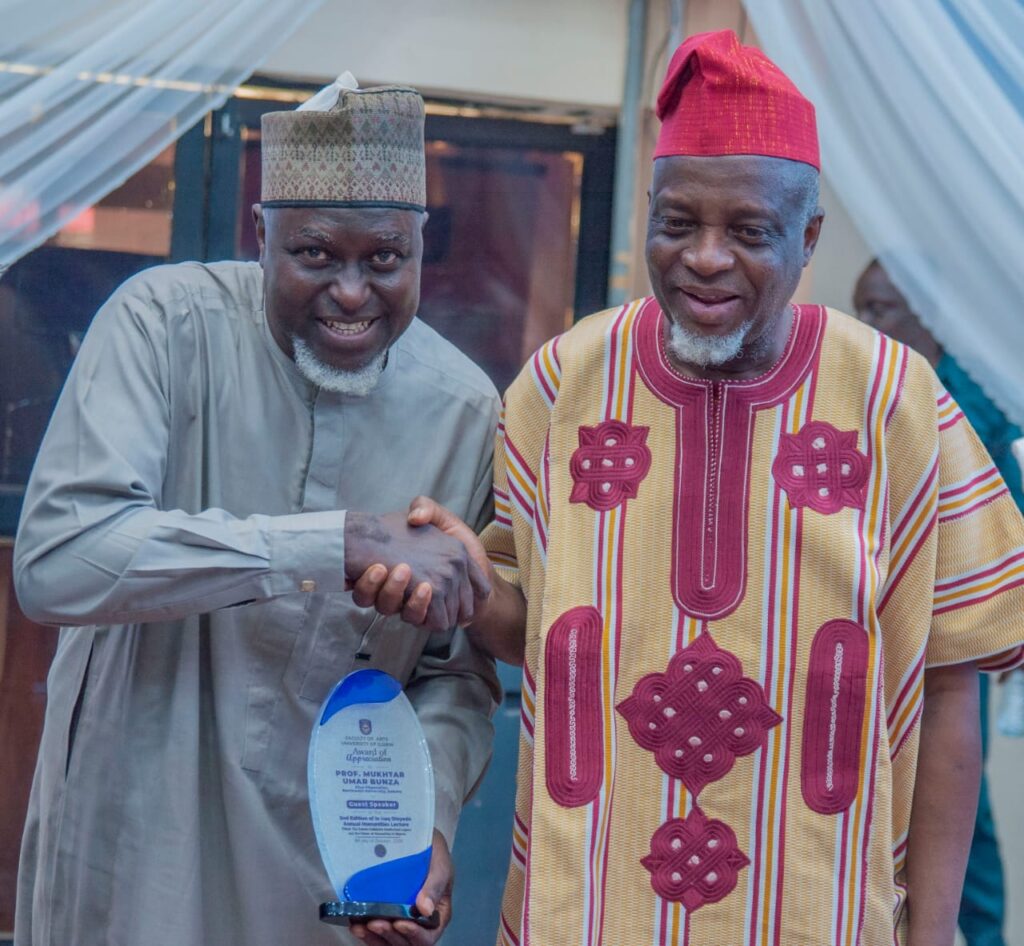
Prof. Bunza stated this last Thursday, (October 8, 2026), in a chat with UNILORIN Bulletin on the sidelines of the 2nd Is-haq Oloyede Annual Humanities Lecture, organised by the Faculty of Arts, University of Ilorin, in honour of Prof. Oloyede.
The Professor of Social History explained that while Shehu Usman Dan Fodio was known for his accommodating disposition and commitment to knowledge, his son, Abdullahi Fodio, was prominent in legal scholarship, while another son, Muhammad Bello, provided political and administrative leadership. He said Prof. Oloyede shares the qualities of all the three leaders, making him particularly suitable for the honour.
Speaking on the theme of the lecture, “The Sokoto Caliphate’s Intellectual Legacy and the Future of Humanities in Nigeria,” Prof. Bunza challenged the perception of the Sokoto jihad as primarily a movement of battle and conquest, describing it instead as an intellectual and knowledge-driven movement.
He said the founders of the Caliphate were students, scholars and writers whose intellectual activities contributed significantly to the development of knowledge in 19th-century West Africa. He added that the intellectual legacy of the Caliphate extended beyond religious studies to areas such as science, medicine, agriculture, town planning, history, economics, political science, diplomacy and other branches of the Humanities.
Prof. Bunza cited works attributed to Abdullahi Dan Fodio and Muhammad Bello in Medicine and other scientific subjects as evidence of the breadth of scholarship within the Caliphate, adding that its leaders also promoted the establishment of schools, libraries and centres of advanced learning.
The Guest Speaker also mentioned the contribution of the Caliphate to women’s education, noting that the emphasis placed on women’s acquisition of knowledge helped foster the emergence of female scholars, including Nana Asma’u and others.
Prof. Bunza, however, observed that the future of Humanities scholarship in Nigeria would benefit from greater use of indigenous intellectual resources. He recalled that scholars such as Prof. Abdullahi Smith had advocated the use of Sokoto Caliphate literature across various branches of the Humanities, stressing the need for Nigerian universities to promote indigenous sources as part of efforts towards self-reliance and home-grown academic training.
In his remarks, the honouree, Prof. Oloyede, called for the establishment of a transdisciplinary research team at the University of Ilorin to examine the intellectual and scientific contributions of scholars of the Sokoto Caliphate.
Prof. Oloyede, who is the Kuliyan-designate of Sokoto, said the University’s strategic location between northern and southern Nigeria, coupled with its rich intellectual and cultural traditions, placed it in a good position to undertake such research.
He advocated deeper interrogation of the historical context of the Sokoto Caliphate, noting that, it should not be understood solely as a military campaign but also in terms of the intellectual capacities, ideas and societal transformation associated with its leaders.
He also called for the strengthening of the Centre for Ilorin Studies through wider research and documentation of Ilorin’s history, identity, relationship with the Sokoto Caliphate, as well as the contributions of notable personalities and institutions.
Prof. Oloyede also challenged students to identify their areas of specialisation and use their knowledge to address societal challenges, rather than merely listening to lectures without identifying opportunities for further research.
The honouree commended the Faculty of Arts on sustaining the annual lecture, describing it as an important platform for intellectual reflection and research development.
Prof. Oloyede further urged the University community to preserve its traditions and values, particularly its recognition of academic excellence, stressing that university awards and honours should be valued beyond their immediate monetary worth as enduring symbols of achievement.
Speaking earlier, the Vice Chancellor of the University of Ilorin, Prof. Wahab Olasupo Egbewole, SAN, said that honouring Prof. Oloyede was also a way of honouring the University.
He described Prof. Oloyede as an individual who had devoted his life to the service and development of the University of Ilorin, adding that he had lived, worked and used the totality of his life to serve the institution.
Prof. Egbewole described the theme of the lecture as contemporary despite the age-long existence of the Sokoto Caliphate, expressing hope that the intellectual engagement would establish a meaningful nexus between the past and the future.
He appreciated Prof. Bunza for honouring the invitation to participate in the second edition of the lecture and commended Prof. Oloyede for his contributions to the development and promotion of the University.
In his welcome address, the Dean of the Faculty of Arts, University of Ilorin, Prof. Ibrahim Abdulganiyu Jawondo, described the 2nd Is-haq Oloyede Annual Humanities Lecture as a programme established to celebrate excellence, hard work, dedication, integrity, trustworthiness, Godliness and service to humanity.
Prof. Jawondo, who described Prof. Oloyede as a disciplined individual whose life and service exemplify these virtues, commended the University Management, under the leadership of Prof. Egbewole, for its support and for providing the necessary facilities that contributed to the success of the programme.
The Dean said that the gathering was not merely about culture, but it is also about humanity, which, according to him, preserves history, encourages interrogation and provides intellectual guidance for society.
