UNILORIN hosts SOSAN Conference on education, heritage, national resilience
By Muizdeen Adewole and Bashir Dawodu
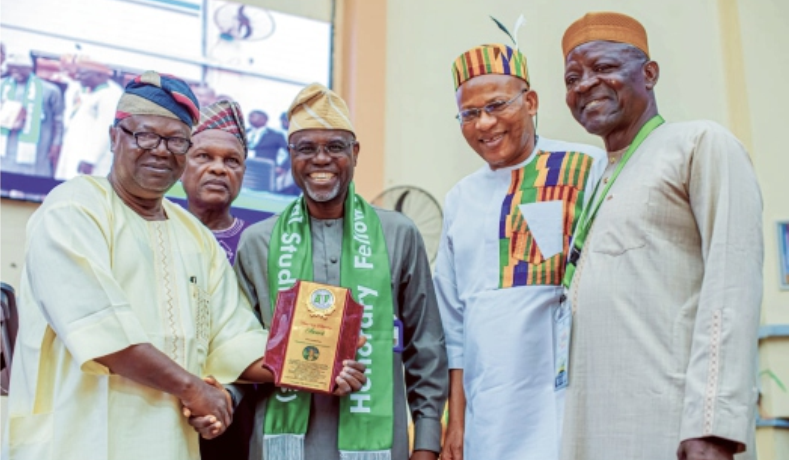
The University of Ilorin hosted the 42nd Annual National Conference of the Social Studies Educationists Association of Nigeria (SOSAN) last Tuesday (August 11, 2026), bringing together scholars, educators, researchers and practitioners to interrogate how education, citizenship, and cultural heritage can strengthen the nation’s resilience and drive sustainable development.
Declaring the hybrid conference open at the University Auditorium, the Vice Chancellor, Prof. Wahab Olasupo Egbewole, SAN, described academic platforms as critical spaces where scholarship must confront the most pressing challenges of the society. He charged the participants to produce ideas that move beyond the ivory tower into policy and practice.
Prof. Egbewole situated the Conference theme in the University’s mandate, stressing the inseparable link between education and culture.
He said, “Cultural values and norms determine how knowledge is transmitted and received”, noting that any education that ignores culture produces citizens who are literate but rootless.”
He reaffirmed the commitment of UNILORIN to programmes that promote cultural awareness, preserve the nation’s heritage, and position the University as a hub for research with measurable societal impact.
The Vice Chancellor further urged universities to align research agendas with national needs, noting that impact must be the new benchmark for scholarship in a time of insecurity, economic pressure and eroding civic values.
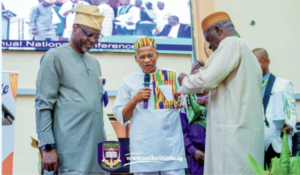
In his welcome address, the National President of SOSAN and Head of the Local Organising Committee, Prof. Abdulraheem Yusuf of the Department of Social Sciences Education, University of Ilorin, said the gathering was more than an academic exercise. It was, according to him, “a convergence of minds committed to national transformation, patriotism and responsible citizenship.”
Prof. Yusuf noted that the Conference theme was a moral call at a time Nigeria faces insecurity, economic hardship, declining civic values, youth restiveness, environmental challenges and widening social divisions. He stressed that Social Studies was conceived to produce informed citizens, not informed spectators, adding that “our task is to raise citizens who think critically, act responsibly, respect diversity, uphold justice and place national interest above selfish ambition.”
On national resilience, he argued that it means more than survival. “It is the courage to rise after setbacks, to remain united despite differences, and to turn adversity into progress. Education must deliberately nurture integrity, compassion, discipline and hope,” he said. He also defined citizenship beyond voter cards and passports, linking it to service, honesty, respect for the rule of law, environmental responsibility, community participation and peaceful coexistence.
Prof. Yusuf, who is the immediate past Director of the Institute of Education, University of Ilorin, warned that while globalisation must broaden Nigeria’s horizons, it must not erase its identity, and he charged delegates to build collaborations and research that can influence government policy.
Setting the intellectual tone for the Conference, the Keynote Speaker, Prof. Dauda Adeyemo Ariya of the Department of Social Science Education, University of Jos, called for a deliberate return to Nigeria’s indigenous governance, civic values and knowledge systems as resources for development.
Prof. Ariya said Nigeria must look beyond conventional policy fixes and recover organising principles that sustained communities before colonial disruption, while adapting them to contemporary institutions, technology and modern knowledge. “This is not a call to return to the pre-colonial past”, he said, adding that “it is an appeal to draw from our history and indigenous knowledge to craft solutions suited to present realities.”
The don linked the country’s development difficulties to a crisis of identity and weak intergenerational transmission, and positioned education as the main instrument for passing civic values and national identity across generations. He urged that indigenous knowledge be treated as a development asset, especially in agriculture, environmental management, local innovation, traditional apprenticeship and community responsibility.
Prof. Ariya proposed a “Nigerian Civilisational Renewal Framework” built on six pillars: Educational Reset, Civic Renewal, Ethical Leadership, Local Innovation, Economic Productivity and Cultural Confidence. He also called for the modernisation of the traditional apprenticeship system to complement classroom learning, and for increased investment in indigenous research.
Flowing from that broad agenda, the lead paper presenter, Prof. Bilqees Olayinka Abdul-Raheem of the Department of Social Science Education, Ekiti State University, Ado-Ekiti, made a case for the integration of Social Studies, Citizenship Education and Heritage Studies as a strategy for building national resilience.
In her paper, titled “Social, Citizenship and Heritage Studies for National Resilience, Civic Responsibility and Sustainable Development,” Prof. Abdul-Raheem argued that insecurity, ethnic and religious tensions, economic hardship and weak national cohesion cannot be resolved by security and policy measures alone. “Sustainable solutions must also address the values we instill through education, how citizens are raised, and the narratives that shape their understanding of Nigeria,” she said.
Prof. Abdul-Raheem introduced a “Three Stones” framework: Social Studies provides critical thinking, Citizenship Education drives responsible action, and Heritage Studies provides cultural connection. She likened the model to the traditional three-stone cooking stand, stressing that stability requires all three. Anchoring her argument on Transformative Learning Theory, Social Capital Theory and Systems Theory, she said that the integrated approach can promote individual transformation, community resilience and national development.
She faulted the current fragmentation of the three subjects across primary and secondary schools, and recommended a single compulsory programme from primary through senior secondary, with regular reviews to reflect emerging issues such as insurgency, corruption, ethnic relations, climate change and inequality.
Linking the proposal to the Sustainable Development Goals, Prof. Abdul-Raheem explained that Heritage Studies can preserve indigenous farming and food-storage techniques, Social Studies can help learners understand the structural causes of poverty, while Citizenship Education can mobilise responsible action.
She further advocated a shift from rote learning to transformative pedagogy, improved teacher preparation and welfare, stronger community participation, and comprehensive curriculum reform. She urged policymakers to treat education as an investment in the future of the country.
