
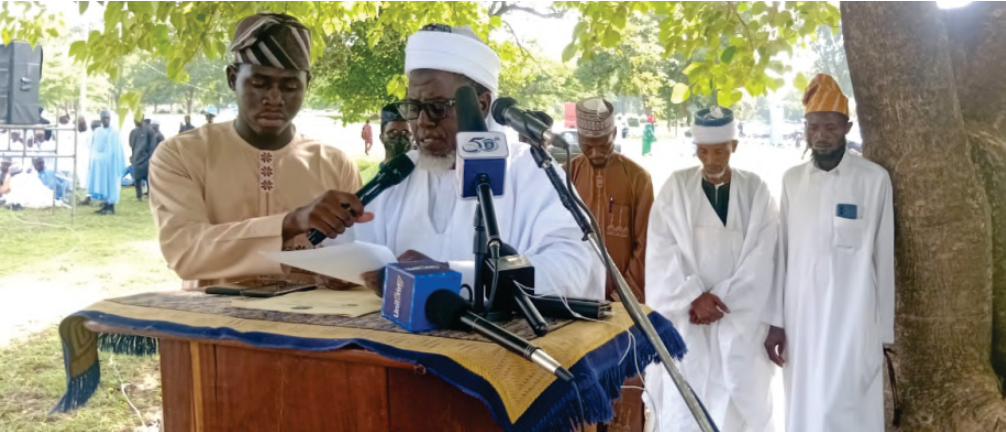
UNILORIN Chief Imam preaches forgiveness in Eid el-Kabir sermon
By Mustafa Abubakar
The Chief Imam of the University of Ilorin, Prof. Nasir AbdusSalam, has urged Muslims to reconnect broken relationships, offer apologies, accept the excuses of those who offend them and maintain cordial relationships as part of the spiritual lessons and moral teachings of Eid-ul-Adha.
This call formed the essence of the 2026 Eid-ul-Adha khutbah the Chief Imam delivered last Wednesday (May 27, 2026) at the University Eid Praying Ground ground, where thousands of Muslim faithful gathered to observe the annual Islamic festival.
The sermon, titled “Sacrifice, Piety and Obedience”, emphasised total submission to Allah, peaceful coexistence, family unity, compassion, and moral uprightness as essential ingredients for building a better society.
The Chief Imam congratulated Muslims as he explained that the occasion represents far more than the slaughtering of animals, describing it as a season of spiritual purification, sacrifice, gratitude, forgiveness, and renewed obedience to Allah as demonstrated by Prophet Ibrahim (AS).
He reminded worshippers that the essence of sacrifice lies not in the shedding of blood alone but in sincerity, devotion, and consciousness of Allah.
Quoting from Qur’an 22:37, the Chief Imam said Allah does not receive the meat or blood of sacrificial animals, but rather the piety and righteousness behind the act.
He, therefore, encouraged Muslims to use the Eid period to repair damaged relationships among relatives, neighbours, colleagues, and friends, stressing that hatred and rancour have no place in Islam.
According to him, Eid should be a period of reconciliation, kindness, mercy, and strengthening of family bonds.
He cited Qur’an 24:22, which encourages believers to forgive and overlook the shortcomings of others in the hope of receiving Allah’s forgiveness and mercy.
The sermon further emphasised the importance of kindness within the family, quoting the saying of Prophet Muhammad (SAW) that “the best among you is the one who is best to his family.”
The Chuef Imam urged Muslims to ensure that members of their households experience love, happiness, compassion, and good treatment through their actions and interactions.
The Chief Imam noted that Islam came to guide humanity towards success in this life and the hereafter through righteousness, justice, good character, and obedience to Allah.
The sermon also highlighted how Islam transformed society by protecting the rights of women, orphans, and vulnerable members of the society at a time when injustice, oppression, and moral decadence were widespread.
He lamented increasing cases of killings, kidnappings, banditry, violence, and social disorder in contemporary society, warning that humanity was gradually drifting back towards barbarism despite the moral guidance provided by Islam over 1,400 years ago.
He, therefore, called on Muslims and Nigerians in general to uphold justice, compassion, honesty, peaceful coexistence, and moral discipline in order to preserve societal peace and stability.
Prof. AbdusSalam specifically advised Muslim women to always support their husbands in obedience to Allah and avoid becoming sources of temptation or disobedience.
The Chief Imam described women as caretakers of the home and urged them to raise children upon righteousness, fear of Allah, and sound Islamic values.
The Chief Imam offered special prayers for peace, security, unity, divine guidance, and prosperity for Nigeria, the Muslim Ummah, and humanity at large.
In his remarks, the Registrar, Mr Mansur Adeleke Alfanla, thanked the Almighty Allah for the gift of sound health and a peaceful atmosphere, urging Muslims to hold firmly to the tenets of Almighty Allah while remaining prayerful and hopeful that conditions in the country will improve for the better.
He also called on Nigerians to pray for the nation, noting that the country is currently facing trials and challenges, and that the situation is bigger than the government alone.
Mr Alfanla further appealed for greater loyalty to the country, stressing the need for a change of attitude among citizens. According to him, Nigerians should be more dutiful, obedient, and sincere in their dealings, both to themselves and to the nation at large, in order to foster unity, stability, and national progress.
In his remarks, the Talba of Ebiraland, Alhaji Hamza Usman, described Eid al-Adha as a moment of divine mercy, noting that it is by God’s grace that believers are granted the opportunity to witness and celebrate another Eid.
He said the season represents sacrifice, sharing, and love, and offers deep lessons that strengthen humanity’s understanding of compassion, patience, and selflessness.
Another regular worshiper at the UNILORIN Eid Praying Ground, Captain Ahmad Mahmoud, noted that the spirit of “Ileya,” as it is popularly called, serves as a reminder of unity, hope, sacrifice, and shared joy among Muslims and the wider society.
He explained that the Eid celebration reflects the lessons of obedience and compassion taught by Prophet Ibrahim, stressing that the slaughtering of rams is not merely a symbolic act, but also a call to strengthen family bonds and show kindness to others.
The Chief Imam had earlier led the congregation in a two-rakaat prayers, which attracted Deans, Directors and Heads of Departments and other staff members as well as students.
