
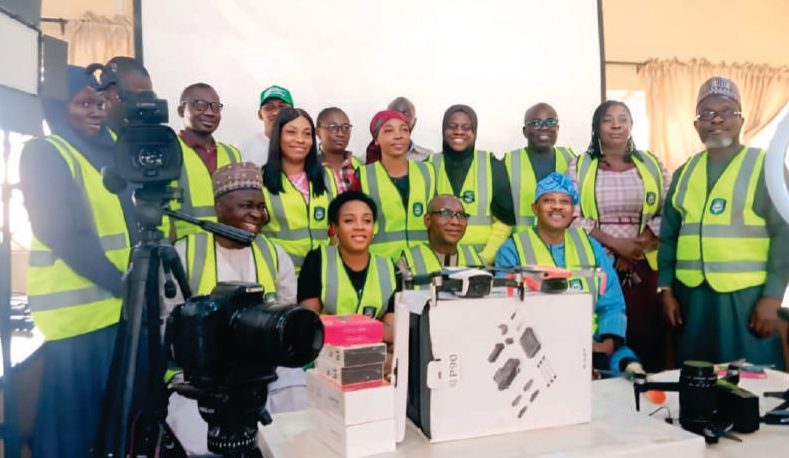
Agric. Dept. launches drone, digital skills training for staff, students
By Abubakar Abdulquadri and Bashir Dawodu
The Department of Agricultural Extension and Rural Development, University of Ilorin, has organised a week-long training to equip staff and students with the innovative skills needed to operate digital tools for agricultural extension service delivery.
The training session, which began last Monday (March 2, 2026)at the Sasakawa Seminar Room, took both the facilitator and the trainees to various spots on the campus for practical sessions.
In his opening remarks, the Dean of the Faculty of Agriculture, Prof. Israel Ogunlade, urged agricultural extension practitioners to embrace specialisation as he declared that the era of general extension practice was over.
The Dean stressed the growing demand for experts in specific fields such as horticulture and poultry, rather than generalists.
Prof. Ogunlade encouraged participants to strive for mastery in particular areas of agriculture for them to remain relevant in an evolving sector.
The Dean charged attendees to improve their competence through continuous learning and constant practice as he also emphasised the importance of leveraging digital tools to record observations and document professional activities.
Prof. Ogunlade commended the Head of the Department of Agricultural Extension and Rural Development for initiating what he described as a unique and forward-thinking training programme. He also expressed confidence in her capacity to advance the Department further and contribute meaningfully to the overall development of the University.
The Guest Speaker, Mr Balogun Arisekola Azeez of Africa Media Concept, explained that the training would be in three parts. He stated that the training will cover the use of drones, the handling of digital cameras, and the editing of pictures and videos. He stated that after the training, participants will be able to use the digital tools.
Mr Azeez, who is a seasoned media consultant, took the participants through the basics of the parts, accessories, and functioning of digital cameras and drones. He explained that there are two types of cameras, the Cam-Coder and the Digital Single Lens Reflex (DSLR) camera. He added that the Cam-Coder camera has two memory cards that can be swapped.
He also trained participants on different types of shots, such as close-up, medium, and wide-angle, saying that such may be required in different situations on farms. He emphasised the importance of self-confidence in using digital tools, particularly the drones.
In an interview with UNILORIN Bulletin, the Head of the Department, Prof. Kemi F. Omotesho, explained that the primary objective of the workshop was to modernise students’ Farm Practical Training (FPT) by transitioning from manual to digital extension service delivery methods. She noted that the training covered drone operation, digital photography, editing, and content creation.
“We are ensuring that every student who passes through our Department is able to fly drones, create agriculture-related contents, and use digital cameras to capture activities on the farm,” she said.
Prof. Omotesho explained that digital tools enhance remote communication with farmers through the exchange of pictures and videos, thereby enabling timely feedback. She added that digital extension has become especially critical in light of security challenges that limit physical visits to rural communities.
Prof. Omotesho commended the University administration for providing funds to procure drones, digital cameras, and other accessories, noting that these resources would benefit both staff and students and also contribute to broader societal development.
She also appreciated the resource person, Mr Azeez, who trained the staff and students as part of the corporate social responsibility of his organisation. She particularly recognised the need for consistent training of the lecturers to enable them to cascade the training to their students.
Also speaking at the event, Prof. Oluwasegun Adekunle said the training marks a turning point for the Department, explaining that he used to be an old-fashioned Professor of Extension Services but is about to transition to a Gen Z Professor.
Prof. Adekunle observed that there were no cameras, drones and more in the olden days’ practice of agricultural extension. He stated that the training will provide them with opportunities to combine the latest communication innovation, drones, highlighting that drones can be piloted from anywhere to the farm and that the farmer will be able to monitor exactly what is going on on the farm.
The renowned agriculturist added that the training was very important and that the initial concept of agricultural extension has now become global.
According to him, the skills acquired during the training will enable participants to function as extensionists in any setting. He appreciated the Head of the Department, Prof. Omotesho, for the significant role she is playing in the development of the Department.
Some of the lecturers present at the training expressed delight. Mrs Halimah Egbewole highlighted the importance of practicalising classroom teaching to reinforce learning beyond theoretical methods.
“I believe practical experience helps students understand better and retain knowledge longer rather than just paperwork,” she said, urging colleagues to adopt more innovative and applied teaching approaches.
Also present at the training were Prof. R. S. Adisa, Prof. L. L. Adefalu, Prof. Sidiqat Abdulwahab-Aderinoye, Prof. Sijuwade Adebayo Dr Ajoke O. Kayode, Dr A. K. Daudu, Dr O. W. Kareem, Dr Tawakalitu Dolapo, Dr Mobolaji Musa, Dr O. P. Olabanji, Dr K.K. Azeez, Mrs Asake Omotoso, Mr Sulyman, and students selected across different levels in the Faculty.
